

New technologies help restaurants combat challenges caused by outdated tech, such as the lack of insights into customer behavior, high no-show rates, wastage, understocking, and inefficient resource allocation. They also help enhance customer experience, optimize operations, and amplify marketing efforts. According to the Restaurant Technology Landscape Report 2024 by the National Restaurant Association, 76% of operators that have already implemented restaurant technologies state that innovative solutions bring them advantages over competitors.
Yet, proper restaurant technology integrations require a clear understanding of the domain specifics. In this article, we share insights on the most promising applications of restaurant tech and some practical advice on implementing it. Our findings are supported by 15 years of experience in software development and more than a decade of developing POS software for the U.S. hospitality sector, and we have collected the most promising cases to pay attention to.
Let’s get started!
Restaurant technology industry landscape in 2026
The restaurant technology market experienced rapid growth in 2024, which continued throughout 2025 and will stay strong in 2026.
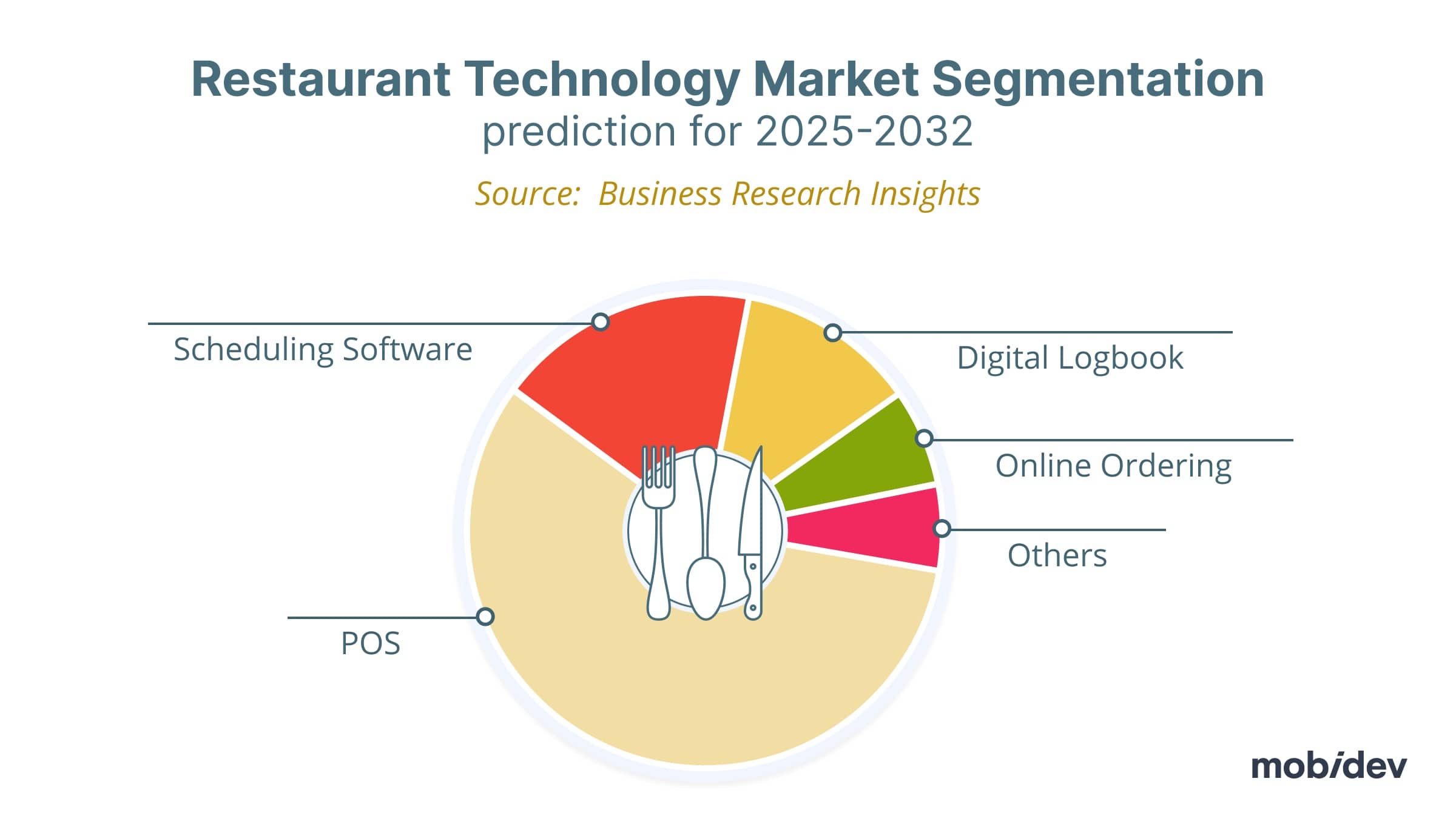
The growth is due to the increasing need for automation, digitization, and the race for data-based solutions. Technologies like Point of Sale (POS) structures, self-service kiosks, and chatbots are already reshaping the way the restaurant industry works, with point of sale structures being the biggest segment of the restaurant technology market.
At the same time, customers expect enhancements in online ordering, app-based delivery and payment, or even more advanced tech perks: robotic kitchens and delivery by drones. Companies like DoorDash and Uber Eats, which were the first to promise innovative service solutions, prove that the implementation of restaurant technologies pays off – DoorDash finished the quarter with a 20% increase in order volumes.
The restaurant sector joins the race to benefit from analytic and generative AI in parallel with other industries. Solutions that allow data-based insights into customer behavior, predictive analytics, and AI-enhanced order and supply management systems are the most popular.
Gen-AI-based service bots take firm positions in the sphere of customer service. The demand for transparency in meal sourcing requires restaurants to be ready with an array of nutrition facts for customers on demand. AI service bots are an excellent solution for taking over educational activity from restaurant staff.
Yet, quite often, the implementation of a new restaurant technology comes with limitations. The dependence on outdated legacy systems is one of them. These systems are slow to scale and unable to integrate with more modern technology, like AI features. At the same time, they are disconnected, leading to manual errors, inefficient resource allocation, and a lot of routine manual labor.
Updating restaurant tech requires large-scale upfront investment and the right talent to translate the business owner’s vision into the best practices of restaurant technology implementation. Quite often, this requires additional consultation from professional services.
To combat the challenges described and reap the benefits of innovations, the hospitality technology niche has taken a firm position in tech investment. The restaurant technology market shows steady growth at a GAGR of 16.39%, according to Business Research Insights. The restaurant tech investment market closed the year in a mini-boom, while top providers of restaurant technology grew, despite the slowdown in restaurant revenues, according to a recent review from Restaurant Business.
At the same time, restaurateurs show readiness to invest in different areas of restaurant tech: from 48% planning to implement point-of-sale solutions (kiosks or tablets) to 63% planning to enhance digital marketing efforts.
While the future of restaurant technology is promising, we’ll have a look at the TOP 8 most interesting restaurant tech use cases to implement.