
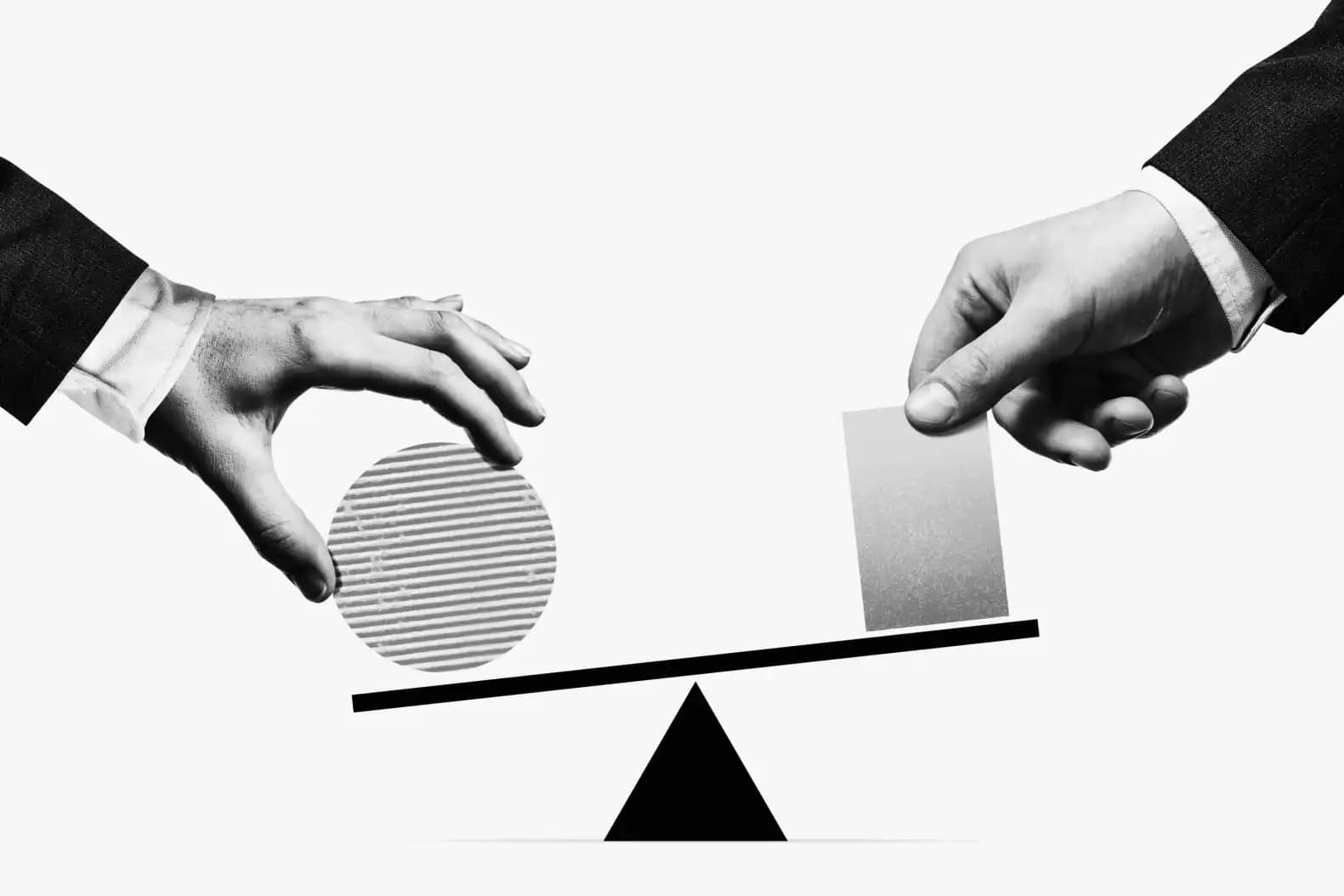
The year 2026 doesn’t feel like the future. It feels like a paradox. On one side, the exponential rise of AI is demanding more speed, more output and more optimization. On the other, the social and cultural climate is fraying under pressure, burnout is rampant, trust is eroding, and people are longing for depth, connection, and meaning.
Professionally and culturally, we are trapped in a binary mindset, a system of “either/or” thinking that is no longer serving us.
You’re told you must choose: profit or purpose. Be competitive or caring. Prioritize technology or protect humanity. Move fast or be mindful. These false dichotomies are exhausting. They’re the mental software of burnout, compelling leaders and teams to sever parts of themselves just to fit into a model of work that can no longer accommodate the complexity we’re living in.
But the truth is: complexity doesn’t require clarity by subtraction, it requires clarity by synthesis.
Jim Collins gave this a name: The Genius of the AND. He studied visionary companies that endured and outperformed, and discovered a common thread: leaders who refused the tyranny of “either/or.”Instead of choosing between short-term results or long-term vision, companies pursued both. They held paradoxes, discipline and creativity, continuity and change, idealism and pragmatism, in productive tension.
That same mindset isn’t just helpful in 2026. It’s essential.
We’re no longer in a world where opposites can be kept in separate silos. Today, leaders must master the ability to lead across contradiction: automation and authenticity, acceleration and stability, profit and people. In a post-pandemic, AI-driven world, AND is no longer just a conjunction, it’s the essential grammar of leadership.
If that mindset had a physical homeland, it would be in a region most travelers overlook on their Italian pilgrimage: Emilia-Romagna.
Tucked between the Apennines and the Adriatic Sea, this region quietly holds one of the most profound contradictions in the world: it is the birthplace of both Slow Food and Fast Cars.
In towns like Parma, Modena and Reggio Emilia, artisans devote decades to mastering time. Parmigiano Reggiano is aged for years. Aceto Balsamico Tradizionale takes decades to perfect. Here, slowness is not laziness; it’s precision. It’s patience as performance. These communities teach a simple but radical truth: slowing down is what makes excellence possible. Quality cannot be rushed.
Yet in those very same towns, engineers obsess over speed. Emilia-Romagna is also known as Motor Valley, home to Ferrari, Lamborghini, Ducati and Maserati. These are teams of people who dedicate their lives to shaving milliseconds off the clock. Their craft is speed, performance and pushing the edge of technological possibility.
These are not two separate cultures, but one. The same engineering DNA that perfects a cheese wheel also builds a V12 engine. The same obsession with detail, quality and mastery runs through both.You have to go slow to go fast.